
Self-Custody as Regenerative Practice
When something “works” until it doesn’t
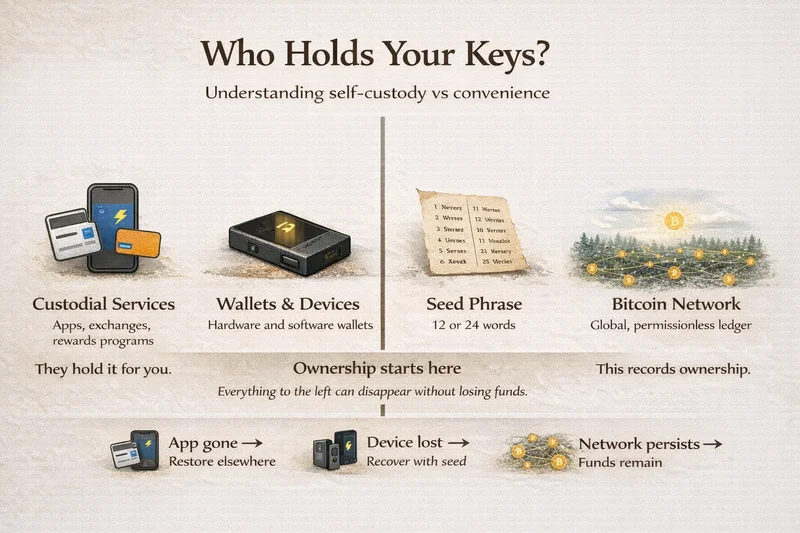
For a time, my Bitcoin lived somewhere else. Not in a wallet I directly controlled, and not in a system I could explain end to end, but on an app—working fine, quietly accumulating in the background. In practice, it meant I was earning and buying Bitcoin without really holding it myself. The keys weren’t mine, the recovery wasn’t mine, and the responsibility ultimately wasn’t mine either. Everything functioned smoothly enough that it was easy not to question it.
A modern spare-change jar.
I’ve been using the Fold Debit card, earning sats (satoshi = .00000001 BTC) in the background. Double round-ups, where every purchase quietly sweeps the spare change into Bitcoin in addition to 5-.5% on purchases and payments. Once the round-up balance exceeds ten dollars, it purchases BTC automatically, regardless of price. And honestly, it works great for me. Over time, those small, passive purchases added up to a significant amount. One day, I was thinking, this isn’t pocket change anymore. That was the moment when self-custody stopped being an abstract idea and became the obvious next step.
Permaculture has a way of opening your mind to patterns that repeat across completely different domains. You start with land and food. The same principles show up everywhere: redundancy, resilience, ownership of the root system, and function stacking. Once those ideas click, it’s hard not to notice how often we already live by them.
Two is One, and One is None
We don’t rely on a single food source, a single energy source, or even a single form of wealth. We use the banking system. However, now, increasingly, we hold Bitcoin as a medium to long term asset. Not just on principle, but as a way to diversify failure modes. Cash is inflationary by design. Land requires stewardship and time. Precious metals are inert but immobile. Bitcoin is digital, bearer-based, and deflationary. None of these replaces the others. They work because they stack and work together to equate to more than just the sum of the parts.
Using custodial apps for Bitcoin is a lot like growing food in raised beds on rented land. You can grow a lot, and you can do good work, but you don’t own the soil underneath it. Self-custody is owning the soil. It doesn’t mean abandoning every other system. We still shop at stores and use banks, but the foundation matters, especially the place you can fall back to when conditions change. In permaculture, saving seed is an act of independence, and in Bitcoin, the seed phrase plays a similar role. It isn’t the resource itself that matters most, but the ability to regenerate access.
I won’t pretend the process was frictionless. There were unclear instructions, moments where the device didn’t behave the way I expected, and at least one small mistake where I surfaced something publicly that I shouldn’t have.
Waiting until I understood everything would have meant never starting. Regenerative systems aren’t learned from manuals; they’re learned by doing, correcting, and continuing. You don’t wait to understand every insect before planting—you plant, observe, and adapt. Self-custody isn’t about being flawless; it’s about reducing dependency over time.
This isn’t necessarily about Bitcoin. It’s about building the habit of ownership. The habit of knowing where things live, understanding recovery paths, and not outsourcing responsibility just because something is convenient. The real asset isn’t the sats; it’s about self-reliance. And once you build that into your life, you recognize it in other parts of your life.
From passive collection to self-custody
This shift into self-custody isn’t dramatic. There was no single breaking point, no crisis that forced the decision. It was the observation that one system in our lives hadn’t yet caught up with the others. On the homestead, we’re constantly iterating—tightening up flows, reducing unnecessary dependencies, and always learning more about the systems we rely on. Moving Bitcoin into self-custody was simply part of that same process of alignment.
I don’t see this as an endpoint. Like any regenerative system, it’s something that will continue to evolve as conditions change and understanding deepens. But it does mark a threshold: a move from passive participation to intentional stewardship. Not because it’s perfect, or even finished, but because it’s now ours to maintain, adapt, and recover if needed
If you’re curious about the technical side of how this works—the nuts and bolts of setting up self-custody, seed phrases, hardware wallets, and recovery paths—I’ve documented that process in detail in a companion piece on thetecnoagrarian.com, where the focus is much more instructional and explicit.
And for those who want to engage directly, support the work, or simply observe how this experiment unfolds over time, I’ll share my public Bitcoin address here as well. Not as a request, but as another expression of transparency and ownership.
Like most things we’re building on the land, this isn’t about optimizing for speed or scale. It’s about cultivating systems that make sense, that can withstand change, and that grow more resilient the longer we tend them.
Lightning address: tecnoagrarian@rizful.com
Self-Custody as a Regenerative Practice on thetecnoagrarian.com