
How I Used AI to Plan a Rabbit Hutch Build


A Simple Rabbit Hutch Plan Was Enough to Inspire Me
We needed a rabbit hutch.
That sounds simple enough, and actually, the original idea was simple. I found a rabbit-hutch design from The Rabbitry Center that gave me a starting point. It was practical, straightforward, and did exactly what a good reference should do: it gave me enough to start thinking about what would work for us.
We had actually been watching The Rabbitry Center on YouTube back when we still lived in Oregon, long before this particular rabbit-hutch project existed.
They are based in Bath, Michigan, just east of Lansing. After moving to the Upper Peninsula, they went from being somebody we watched online from the other side of the country to somebody we could realistically get rabbits from.
Realistically is relative.
From Cornell, it is still roughly five hours of driving each way, so if everything works out, picking up rabbits is going to be a full-day road trip rather than a quick run into town.
I respect The Rabbitry Center for more than just the hutch design. They consistently put useful information out into the world. They raise rabbits, sell rabbits, make videos, have a podcast, and have an Amazon store with equipment they actually use.
The production was not highly polished at first, but they execute consistently.
I tend to lean the other way.
I like thinking through details. I like polishing a plan. And if I am not careful, I can keep improving the plan long after the plan is good enough to execute.
That became part of this project too.
Starting With an Idea and Letting It Change
From the beginning, I decided to use AI to help me work through the design.
I can draw by hand, but designing this hutch was a real project for me, not something I could confidently solve with one quick sketch. I wanted dimensions I could refer back to, clearer drawings, something close to a cut list, and enough documentation that everything I figured out this time would still be useful when I build the next one.
So the first phase was a lot of back-and-forth.
The drawings would get made, I would look at them and find things that were wrong, and then we would revise them. A support would be in the wrong place. A roof member would not line up correctly. A dimension would be measured from the wrong point.
Then we would go around again.
Eventually, the drawings were good enough.
Not perfect. Good enough.
That distinction mattered because at some point I had to stop planning the rabbit hutch and actually build the rabbit hutch.
You can keep polishing a turd until the polishing becomes the project. At some point I had to stop improving the plan, pick up the lumber, and let the build tell me what still needed work.
The Design Changed as Soon as I Started Building
Once I started building, the project immediately began changing.
That is one of the things I like about building. Once the design becomes a physical structure, you start getting feedback that no drawing can give you.
Wood has actual dimensions. Roofing comes in actual manufactured lengths. The cages have to slide in and out. Fasteners have to land somewhere. A detail that looked fine on a drawing can suddenly be awkward when you are standing there with lumber in one hand and a drill in the other.
So I changed things.
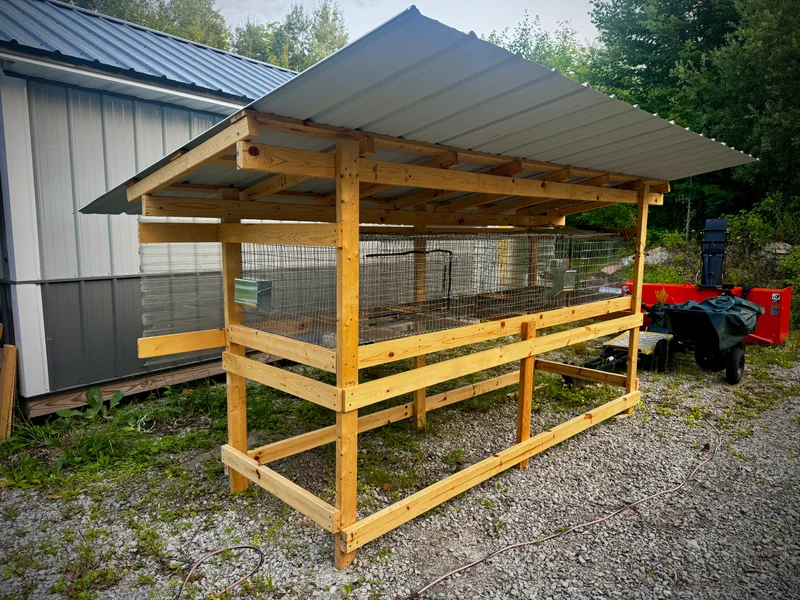
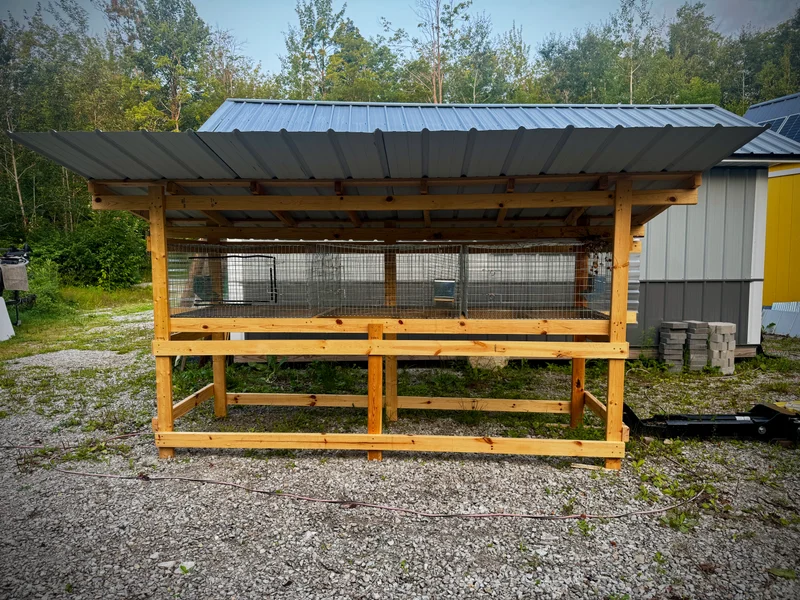
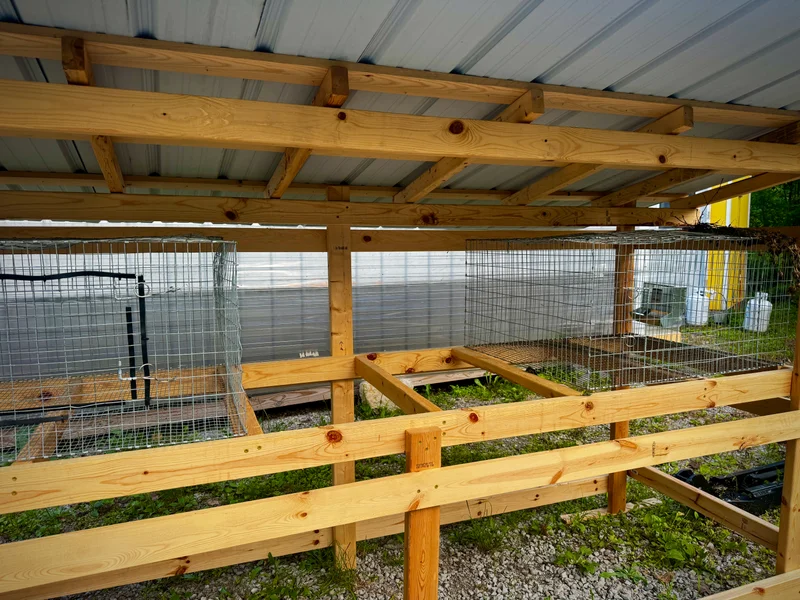
The planned X-bracing went away and horizontal rails replaced it. The roof framing evolved during the build. I decided not to cut the manufactured roofing panels down, which gave me more covered area than I had originally planned and created useful space for food, hay, and working around the cages.
The cage supports changed too. Wider supports could carry the edges of neighboring cages, while narrower supports in the middle reduced how much horizontal surface there was to catch manure.
The final hutch was still the same basic project I had started designing, but it was no longer exactly the structure that existed in the drawings.
That did not bother me.
That is what building is.
The Structure Became the Next Draft
After the hutch was built, I could have called the project finished.
And if I had sketched it by hand at the beginning, that is probably exactly what would have happened. I would have a functioning rabbit hutch, a few measurements scribbled somewhere, and maybe a drawing I would never look at again.
Instead, I went back through the whole project one more time.
After the build, I was no longer asking whether the hutch matched the plan. I was asking whether the documentation matched the hutch.
I took measurements from the finished hutch. We used photographs to verify parts of the structure. I went back through assumptions that had survived from the original design and corrected the ones that were no longer true.
Some details were easy to measure.
Some could be clearly seen in photographs.
Some I knew because I made the decision while I was building it.
And some things had never been recorded well enough to pretend that we knew them exactly.
That distinction ended up becoming part of the final documentation.
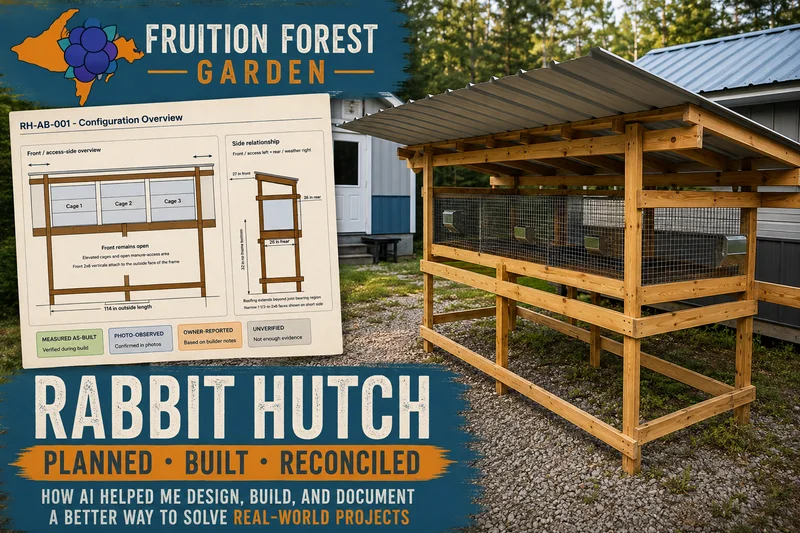
MEASURED AS-BUILT.
PHOTO-OBSERVED.
OWNER-REPORTED.
UNVERIFIED.
I like having UNVERIFIED in there. It is a simple way of saying that a project does not become more useful just because you pretend to know something you do not actually know.
After construction, the finished hutch became the reference point and the documentation had to be updated to match the real build.
By the time all of that was done, the rabbit hutch had turned into a 13-page Builder Package. Rabbit Hutch Builder Package (PDF)
That was definitely not what I thought I was starting when I decided I needed somewhere to keep rabbits.
The package includes as-built drawings, materials, practical cut information, a build sequence, notes about the decisions that changed during construction, and a section specifically describing what the documentation does not establish.
I am not presenting it as a perfect plan.
It is not professionally engineered. It does not tell you exactly which screw to drive into every board. Some dimensions were never recorded and are intentionally left for the builder to work out in the field.
I am sharing it because it might give somebody else ideas.
That feels closer to what I appreciate about The Rabbitry Center in the first place.
Their simple design gave me somewhere to begin. My finished hutch is substantially different, but the idea moved forward because somebody else had been willing to put useful information out there.
The Rabbit Part Is Still Coming
The structure is finished, but the rabbit project is not.
This is not the hutch’s permanent location. We tend to move our living spaces and animal setups as circumstances change, and this property gives us even more options. The rabbits will begin near the cabin and move again as the homestead evolves.
Our current plan is to get the rabbits from The Rabbitry Center if the timing works out. They only allow a short hold on rabbits, so we cannot reserve them months in advance and forget about them. We are hoping to make the trip down to Bath around the middle of September.
There is something satisfying about that connection.
We watched their content when we lived in Oregon. Their simple hutch design later helped spark this project after we moved to the UP. And if everything works out, the first rabbits living in our substantially reworked version will come from their rabbitry too.
So, for now, I have a rabbit hutch without rabbits.
That should be temporary.
Eventually, I want the pictures from this project to look a lot less like lumber and wire cages and a lot more like rabbits.
Good Enough to Build, Good Enough to Share
The biggest lesson for me is probably not about rabbit hutches.
It is about knowing when the planning phase has done its job.
I can keep working on an idea forever, especially with AI involved. There is always another question. Another improvement. Another version.
But eventually, the project needs information that only the real world can provide.
The drawings got good enough, so I built the hutch.
The hutch showed me what the drawings got wrong.
Then I used that information to make the documentation better.
And now I am putting it out there.
Not because it is perfect.
Because it is useful.